
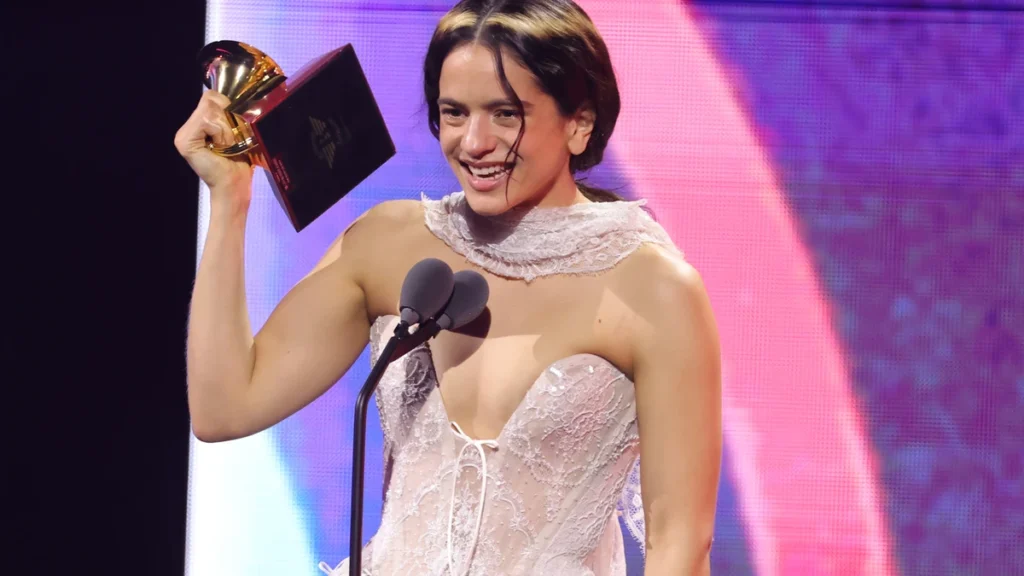
La Perla was named song of the year at the 27th Latin Grammys on Thursday night, and before the ceremony in Las Vegas was over, the woman who sang it had taken the biggest award too. Rosalía won album of the year for Lux, her third win in the category, at the MGM Grand Garden Arena on 12 November.
It was a night built around one record. Rosalía opened the show with songs from Lux, collected song of the year and best pop song for La Perla, and left with the top prize. Here is what she won, what she said, and how the rest of the night unfolded around her.
A Third Album of the Year, and a First for a Woman
Rosalía has now won the Latin Grammys’ biggest award three times. Her first came in 2019 for El Mal Querer, the album that made her name, and her second for Motomami in 2022. With Lux she becomes the first woman to win the award as a lead artist that many times, Rolling Stone reported.
She was already in tears when she reached the stage, where the award was handed to her by the Colombian singer Juanes. Rosalía recalled how he had helped her at the start of her career. “The fact that you’re the one giving me this award is so powerful,” she told him, according to Rolling Stone.
Then she spoke about the record itself. “For me, Lux has been a leap into the abyss. I think it’s really important to speak your truth and that everyone else can share their truth. This album has been mine,” Rosalía said in her speech.
La Perla Took Song of the Year Too
The song that carried the night was La Perla, her collaboration with the American urban sierreño trio Yahritza Y Su Esencia. It won song of the year, an award for the songwriters, who are credited as Noah Goldstein, David Rodríguez, Rosalía, Ryan Tedder and Dylan Wiggins, according to Variety’s winners list. It also won best pop song.
When she accepted song of the year, Rosalía thanked Mexico and invited Yahritza Y Su Esencia to join her on stage, the Associated Press reported. The pairing shows the album’s reach: a Spanish singer with a conservatory training, sharing the hook with an American urban sierreño trio.
Variety’s list also credits her with best short form music video, for Sauvignon Blanc.
How Lux Opened the Show
Rosalía also opened the broadcast. She sang a medley of La Rumba Del Perdón, La Perla and Dios Es Un Stalker, joined by dancers wearing halos on a stage designed to look like heavenly clouds, the Associated Press reported. The AP called the album “an offbeat, full-hearted embrace of her classical training through huge orchestral movements, inspired by the lives of female saints.”
Rolling Stone described Lux as the work of a trained conservatory musician, blending classical music, opera and 14 different languages into a project about theology, love and womanhood. Released in the autumn of 2025, the album became the basis for this year’s Lux world tour, which Rosalía staged with a full orchestra.
That ambition set it apart in a field of strong pop and urban records.
The Field Rosalía Beat
The album of the year category was crowded. Rosalía was up against Jorge Drexler, Karol G, Carín León, Anitta, Mon Laferte, CA7RIEL & Paco Amoroso, Silvana Estrada, Rawayana and Milo J, Rolling Stone noted. She went into the night tied for seven nominations with three of those rivals: Karol G, CA7RIEL & Paco Amoroso and Jorge Drexler. The producer Edgar Barrera led all nominees with ten.
Several of her rivals still had good nights. Karol G won best urban music album for Tropicoqueta. Jorge Drexler took best singer-songwriter album for Taracá. Milo J won best folk music album for La Vida Es Más Corta, and CA7RIEL & Paco Amoroso won best pop/rock song for Hasta Jesús Tuvo Un Mal Día, recorded with Sting. Juanes, who later handed Rosalía her trophy, won the first award of the night, best pop/rock album, for JuanEsteban.
Among the pop categories, Alejandro Sanz won best contemporary pop album and Laura Pausini best traditional pop album, according to Variety’s list.
Daddy Yankee and the Rest of the Night
If Rosalía owned the awards, Daddy Yankee owned the middle of the show. Named the Latin Grammys’ person of the year, the first Latin urbano artist to receive the honour, he ran through Ella Me Levantó, Con Calma, Despacito, Rompe and Gasolina among others, joined by guests including Bizarrap, Bad Gyal, Feid, French Montana and LL Cool J, the AP reported.
Janet Jackson presented his award “with admiration and respect,” as she said in her speech. Daddy Yankee closed his acceptance with a line about his home island: “Puerto Rico, recuerda. … Puerto Rico no es pequeño. Pequeño el mapa.” The AP translated it as “Puerto Rico, remember. … Puerto Rico is not small. The map is small.” He also shared best urban song with Bizarrap for their Bzrp Music Session.
Best new artist went to the Colombian singer Aria Vega, who gave her acceptance speech through tears. This year the Latin Recording Academy changed the rules for that category, so that only artists with fewer than three albums or 25 singles released were eligible. The ceremony was hosted by Roselyn Sánchez and aired live on Univision, UniMás, Galavisión and ViX.
The performances spread across the region’s styles. Karol G sang her música mexicana ballad Ese Hombre es Malo with a full orchestra and 12 mariachis, Mon Laferte performed Femme Fatale, and Silvana Estrada played Dime on the Venezuelan cuatro, a four-stringed instrument similar in structure to a ukulele, the AP reported. Milo J performed Solifican12 and Gil with Gustavo Santaolalla, Carín León sang Desde Que Te Tengo, and Anitta ran through a medley of songs from Equilibrium in Portuguese, Spanish and English before returning to collect the award for Portuguese language contemporary pop album.
There were two tributes. Edgar Barrera produced one for the ranchera songwriter José Alfredo Jiménez, with The Warning covering Te Solté la Rienda, Reik singing La Media Vuelta, Sofía Reyes and Yami Safdie sharing Si Nos Dejan and Camila Fernández closing with El Rey. The second honoured Willie Colón, the salsa pioneer who died in February, with his son Miguel Colón, Nathy Peluso and Luis Figueroa among the performers.
What Her Speech Said About Lux
Rosalía ended her album of the year speech by thanking the person she credits with shaping her. “Thanks, mama, for making me this way. I’m going to bring this Grammy to your house. I don’t know if another one is going to fit in your house, but I’ll bring it to you anyways and see if you make room. You always find a way for anything,” she said, according to Rolling Stone.
It was a light end to a speech that began with a leap into the abyss, and it fits the album’s mix of the devotional and the domestic. Lux asks a lot of a listener, with its orchestral passages and its many languages, yet La Perla still won best pop song as well as song of the year.
What Comes Next for Rosalía
Three album of the year wins puts Rosalía in a category of her own among women at the Latin Grammys, and it arrives after a year spent taking Lux on the road with an orchestra. Pop artists keep crossing between languages, at every level of the business: this site recently covered how Vamos became the first Spanish-language single from Lola Parks.
Not every winner was looking ahead. Bobby Pulido, who won best Tejano album during the Premiere Ceremony held before the broadcast, used his speech to announce that he is retiring from music, days after he was elected to the US House of Representatives, the AP reported. “I want to tell you that I’m retiring from music, and I’m leaving with so much gratitude,” he said.
For now the next stop for Rosalía’s trophy is her mother’s house, if she can make room. The ceremony confirmed what the medley at the top of the show suggested: in a year of big pop and urban records, an album built on orchestras, opera and 14 languages was the one that won.
About Author