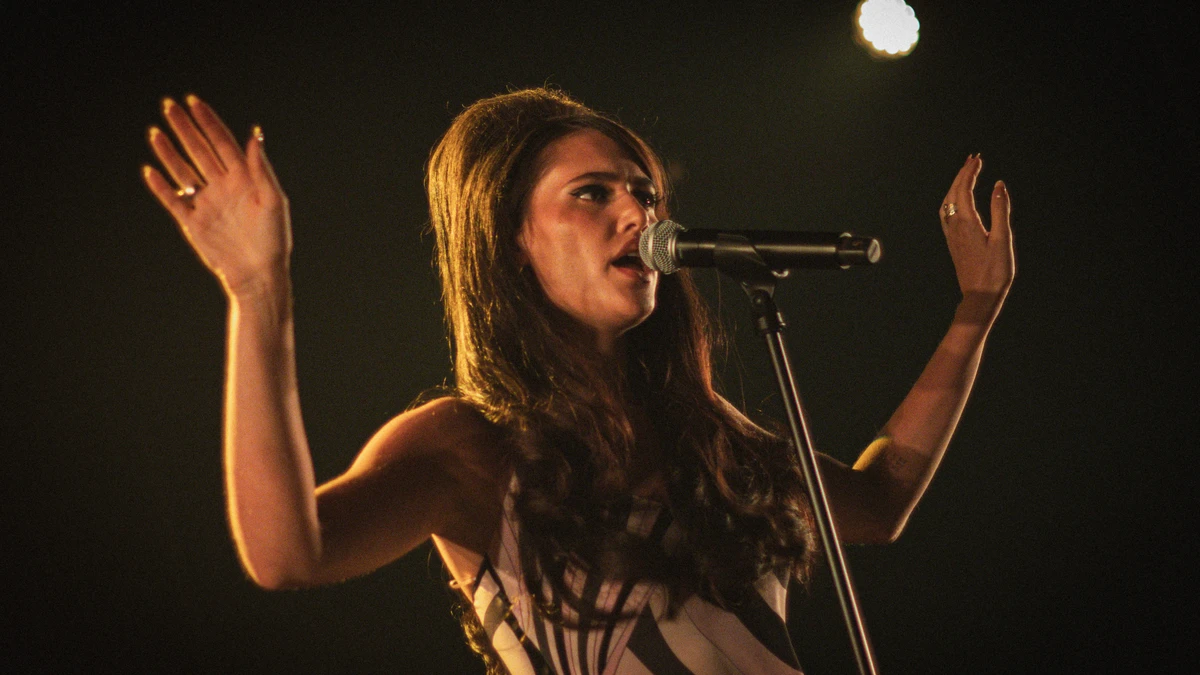


Gracie Abrams scored her first Billboard 200 number one with her third album.
Gracie Abrams scored her first Billboard 200 number one with her third album.
Two years ago Gracie Abrams released The Secret of Us and it opened at number two on the Billboard 200 with 89,000 equivalent album units. Her third record went one better. Gracie Abrams Daughter From Hell entered the chart at number one with 124,000 units, a 39% jump on the album before it and the largest first-week pop debut of the year.
It is her first Billboard 200 chart-topper, and it arrived alongside the most divided set of reviews she has ever had. Both things happened in the same seven days, and the gap between them is the interesting part.
The Numbers Behind the No. 1
Of those 124,000 equivalent album units, 77,000 were pure album sales, comfortably the best sales week of her career. That ratio matters. An album can reach number one on streaming volume alone, but a sales-heavy week means people are actively buying an object rather than passively adding songs to a playlist, and that is the metric labels read as commitment.
Put differently, pure sales accounted for roughly 62% of the first-week total for Gracie Abrams Daughter From Hell. Most chart-topping pop albums invert that ratio, with streaming doing the heavy lifting and physical copies topping up the margin. A week weighted this far toward purchases usually signals two things at once: a fanbase willing to pre-order, and a release strategy built around physical variants that reward them for doing so.
She is the sixth act to score a first Billboard 200 number one in 2026. For an artist who released her debut album in 2023 and has spent the period since building through touring rather than radio saturation, that is a fast arrival at the top of the chart.
The record itself came out on 17 July through Interscope, sixteen tracks produced by Abrams with Aaron Dessner and Dan Nigro. Three singles led it out: “Hit the Wall” in May, “Look at My Life” in June and “Good Reason” a week after release. The guest list is quietly heavyweight, with Justin Vernon on “Hit the Wall” and “Humming,” Marcus Mumford on “What If It’s Right?” and Paul Mescal credited as a co-writer on “Imaginary Friend.”
The Reviews Went the Other Way
On review aggregator AlbumOfTheYear, Daughter from Hell sits at 59 out of 100 across fifteen critic reviews. That is not a savaging, but it is a long way from the reception a chart-topping pop record usually gets, and the spread underneath the average is unusually wide.
At the top, Rolling Stone’s Angie Martoccio filed a 90, calling it Abrams’ best album yet and praising sixteen tracks that “sparkle with angst, beauty, and all the baggage.” At the bottom, Paste’s Grace Robins-Somerville scored it 33 and dismissed the record as “an already-dated relic of the COVID era of pop music.”
Between those poles sit The Irish Times at 80, Consequence at 67, Pitchfork at 62, and a tight cluster of 60s from AllMusic, NME, Clash and Hot Press. The Guardian’s Laura Snapes and the Sydney Morning Herald’s Annabel Ross both landed on 40.
Where the Critics Actually Disagree
Read the reviews side by side and they are not arguing about the songs. They are arguing about whether the persona holds.
The album’s premise, announced in its title, is a reckoning with being difficult. The sceptics say the reckoning never materialises. Snapes called it a “bloodless record” and concluded that “we never really learn how she raised hell.” The Times’ Will Hodgkinson made a near-identical point, noting that Abrams “doesn’t actually list her crimes.” Pitchfork’s Molly Mary O’Brien found the record “incredibly intense” and “frustratingly vague” in the same breath.
NME’s Rhian Daly, scoring it 60, framed the same gap as a question of craft rather than honesty: “More plodding than enlightened, the 26-year-old singer-songwriter’s contemplative third album shows she still has more growing to do.” Daly still singled out “Sober” as “a gorgeous piece of work that gently builds into something devastating,” while finding the title track “plodding and dirgey.”
The defenders read the restraint as the point. In a round-up of the reviews, the Associated Press’ Elise Ryan praised a “broader array of instruments and production styles” and argued her voice “has strengthened since her restrained debut,” picking out “Good Reason” and “Afflictions.” Harper’s Bazaar’s Sophie Wang described the sixteen songs as “a glimpse into the inner mind of a young woman striving to shed” the armour of adolescence.
The Audience Score Is Lower Still
The detail most likely to matter commercially is that listeners were harder on it than critics. The same aggregator lists a user score of 53 out of 100 from more than 2,600 ratings, six points below the critic average.
That inversion is worth watching. A record can survive a critical shrug indefinitely if the fanbase is evangelical, and pop has a long history of albums that reviewers filed at 60 and audiences played for a decade. It is less comfortable when the people who bought 77,000 copies in week one are grading it below the professionals.
One week of ratings is a small sample and skews toward early, invested listeners, so it should not be over-read. But it does complicate the simplest version of this story, in which a beloved artist finally gets her number one and the critics are merely slow.
A Number One Is Not the Same as a Consensus
The tension here is structural rather than personal. Abrams’ commercial machine is working exactly as designed: a devoted audience, a heavy touring base, a physical-sales strategy that converts that audience into chart units in a single week. None of that requires critical agreement, and the 39% jump over The Secret of Us shows it compounding.
What a 59 average does affect is the longer arc, the year-end lists and awards conversations where a record needs advocates outside its own fanbase. Olivia Rodrigo’s own number one this year arrived with both halves aligned, which is the version every label wants.
It is also fair to note that fifteen reviews is a modest sample and that aggregate scores flatten genuine disagreement into a single misleading number. A record that produces a 90 and a 33 is not a mediocre record. It is a polarising one, which is a different and generally more durable thing.
What the Tour Has to Answer
The next test is live. Abrams has announced a 64-date arena run under the Look at My Life banner, opening in Denver in December and carrying through North America into spring before heading to Europe.
Arena rooms are unforgiving to the exact quality the critics flagged. Songs built on restraint and interiority have to be re-scaled without losing what made them work, and the reviewers who praised the record’s “broader array of instruments and production styles” were describing exactly the material most likely to translate. If Daughter from Hell plays bigger than it reads, the 59 stops mattering quickly.
For now the scoreboard is split cleanly down the middle: the biggest commercial week of her career, and the widest critical spread. Gracie Abrams Daughter From Hell is the first record where those two lines have pulled apart, and which one bends toward the other over the next six months is the real story.
This article was AI-assisted and edited for accuracy.
About Author